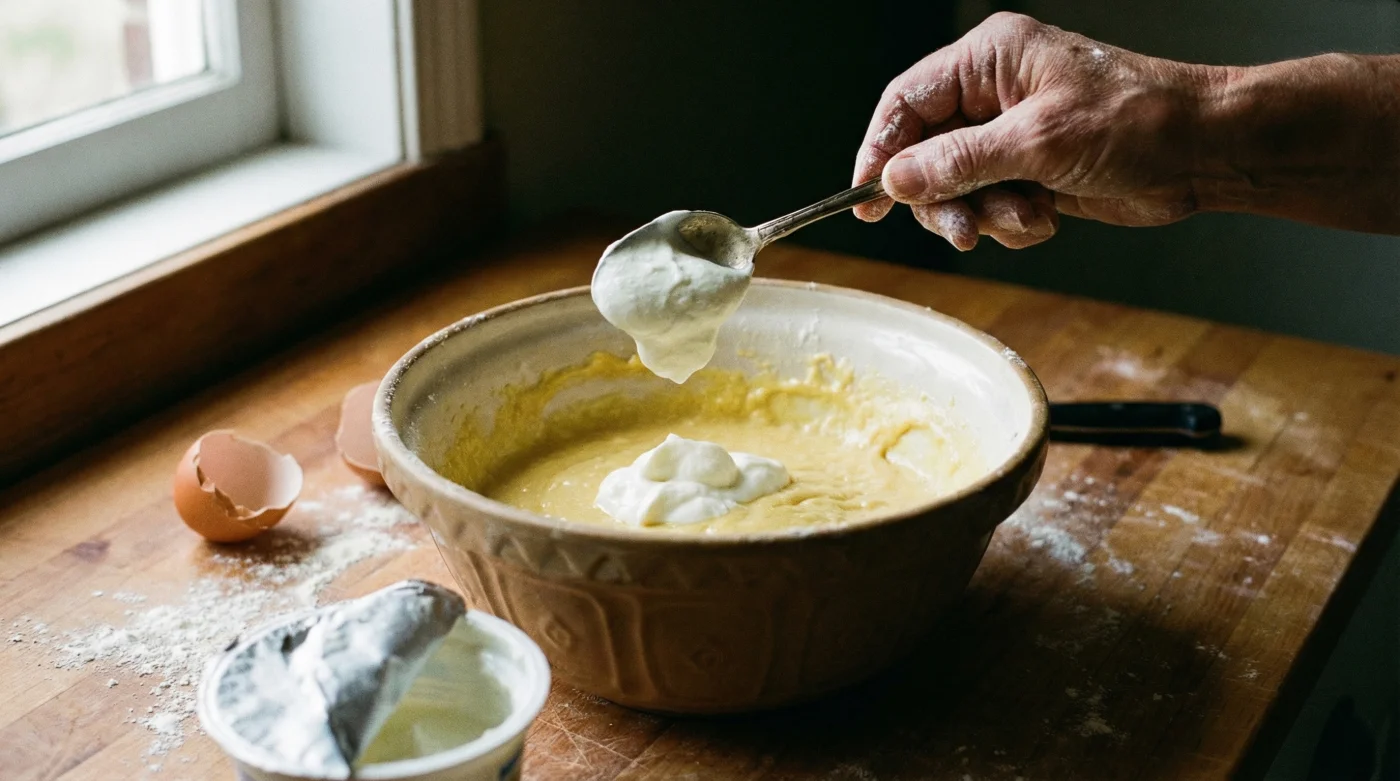
There is arguably nothing more disheartening for a home baker than slicing into a beautifully risen Victoria Sponge, only to find the texture resembles dry cardboard rather than a tender cloud. For generations, British kitchens have adhered religiously to the doctrine that blocks of unsalted butter are the absolute prerequisite for structural integrity and richness in baking. However, a quiet revolution is taking place in professional test kitchens across the UK, challenging the fundamental physics of baking fats and moisture retention.
This pivotal ingredient switch does not merely reduce the caloric density of your favourite Sunday afternoon treat; it fundamentally alters the crumb structure, introducing a level of hydration that butter simply cannot achieve in isolation. By exchanging heavy solid fats for this cultured powerhouse, you introduce natural acidity that reacts vigorously with raising agents for a superior lift, while dense protein networks lock in moisture for days. Before you automatically reach for the butter dish again, you must understand the mechanisms of the Greek Yogurt technique.
The Science of Acidity and Protein Networks
While butter provides flavour and aids in aeration during the creaming process, it lacks the biological complexity required to actively tenderise wheat gluten. Greek Yogurt, specifically the strained variety found in UK supermarkets, is rich in lactic acid and milk proteins (casein and whey). When introduced to a batter, the acidity (pH 4.4–4.8) performs a dual function: it weakens the tough gluten strands found in flour, resulting in a softer crumb, and it reacts instantaneously with bicarbonate of soda to create carbon dioxide bubbles for increased volume.
Furthermore, the water content in yogurt is bound within a protein matrix. Unlike water added directly to a mix, which evaporates rapidly in a 180°C oven, the moisture in yogurt is released slowly. This prevents the ‘staling’ process, keeping cakes moist for up to four days longer than their butter-based counterparts. However, not all yogurts are created equal; using the wrong type can lead to a disastrously gummy bottom layer.
Understanding the chemistry is vital, but seeing the direct nutritional and textural trade-off makes the decision to switch undeniable.
Table 1: The Baker’s Comparison – Butter vs. Greek Yogurt
| Feature | Standard Butter (Unsalted) | Full-Fat Greek Yogurt |
|---|---|---|
| Primary State | Solid Fat (80% Fat) | Semisolid Emulsion (10% Fat) |
| Moisture Content | Low (approx. 16-18% water) | High (approx. 75-80% water) |
| Reaction with Soda | Neutral (Requires added acid) | Highly Reactive (Self-activating) |
| Crumb Texture | Dense, Rich, Flaky | Velvety, Moist, Springy |
| Caloric Density | 717 kcal per 100g | Approx. 95-130 kcal per 100g |
Mastering the Ratio: How to Substitute Correctly
Simply swapping ingredients gram-for-gram can be perilous if one does not account for the additional water content in yogurt. While butter is 80% fat, Greek yogurt is significantly leaner, even in its ‘full-fat’ state. To maintain the structural richness of a bake, the substitution must be calculated carefully. Culinary experts advise against using yogurt as a 100% substitute in cookies (which require solid fat to hold shape), but it is the superior choice for cakes, muffins, and quick breads.
For the optimal ‘moist-crumb’ architecture, you must differentiate between ‘fat replacers’ and ‘moisture enhancers’. If you remove 100g of butter, you lose 80g of fat. Therefore, a partial substitution often yields the best balance of flavour and texture for beginners. However, for those seeking maximum moisture, the Total Swap Protocol can be used if the raising agents are adjusted accordingly.
- Open window trickle vents permanently eradicate toxic winter black mould
- Coffee grounds scattered at dusk permanently repel midnight slug invasions
- Aaron Taylor Johnson secures the most lucrative James Bond contract ever
- King Charles revokes Royal Lodge security to force Prince Andrew out
- EON Productions confirms Aaron Taylor-Johnson signs the historic 007 contract
Table 2: Substitution Matrix by Bake Type
| Bake Category | Substitution Ratio | Technical Adjustment |
|---|---|---|
| Sponges & Madeira Cakes | 1:1 Ratio (reduce liquid slightly) | Reduce milk in the recipe by 2 tablespoons per 100g of yogurt used. |
| Muffins & Loaf Cakes | 0.5 Butter : 0.5 Yogurt | Cream the butter and sugar first, then fold in yogurt with wet ingredients. |
| Brownies | 0.75 Yogurt : 0.25 Butter | Increases fudginess significantly; bake time may increase by 3-5 minutes. |
| Dense Fruit Cakes | Not Recommended | Acid content may interfere with slow-baking fruit suspension. |
The Diagnostic Guide to Yogurt Baking
Integrating a wet, acidic ingredient into a delicate emulsion requires precision. If your yogurt-based cakes are failing, it is rarely the fault of the ingredient itself, but rather the application or the fat percentage chosen. Low-fat or ‘Greek-style’ yogurts (which are thickened with starch rather than strained) release water too quickly, leading to the dreaded ‘soggy bottom’.
Use this diagnostic checklist to troubleshoot your texture issues:
- Symptom: The cake has sunk in the middle.
Cause: Over-activation. The acidity in the yogurt reacted too violently with the raising agent before the structure set. Fix: Get the cake into the oven immediately after mixing; do not let the batter sit. - Symptom: The texture is rubbery or gummy.
Cause: Protein coagulation. You likely used 0% fat yogurt. Fix: Always use 5% or 10% fat Greek yogurt. The fat coats the flour proteins, preventing toughness. - Symptom: The mixture curdled before baking.
Cause: Temperature shock. Cold yogurt was added to creamed butter/sugar. Fix: Ensure the yogurt is at room temperature (21°C) before mixing.
Now that you can troubleshoot potential pitfalls, identifying the correct product on the supermarket shelf is the final hurdle to success.
Selecting the Correct Culture
The UK market is flooded with products labelled ‘Greek-Style’, which are often standard yogurts thickened with guar gum or cornstarch. These imposters do not possess the strained protein density required for baking physics. Authentic Greek yogurt (strained) has had the liquid whey removed, resulting in a higher protein count per gram and a lower water content. This density is non-negotiable for the perfect crumb.
When scanning the aisle, ignore the branding and look strictly at the ingredients list and nutritional data.
Table 3: The Greek Gold Standard (Buying Guide)
| Factor | The Gold Standard (Buy This) | The Ruiner (Avoid This) |
|---|---|---|
| Ingredients List | Milk, Cream, Live Cultures (Lactobacillus) | Milk, Starch, Thickeners, Pectins, Gelatine |
| Fat Content | Minimum 5% (Total 10% is ideal) | 0% Fat or ‘Light’ versions |
| Texture in Pot | Stiff peaks, holds shape on spoon | Runny, pours easily |
| Protein Content | High (approx. 9g-10g per 100g) | Low (approx. 3g-4g per 100g) |
The Ultimate Method for the Perfect Crumb
To execute this technique perfectly, begin by bringing 250ml of full-fat strained Greek yogurt to room temperature. If your recipe calls for 250g of butter, use 125g of butter and 125g of yogurt for the safest, most delicious transition. Cream your butter and sugar until pale, then beat in your eggs. Here is the critical step: fold the yogurt in alternately with your dry ingredients (flour and raising agents).
Add one-third of the flour, mix gently, then half the yogurt, then flour, then the remaining yogurt, finishing with flour. This ‘sandwich’ method prevents the emulsion from breaking and ensures the acidity is distributed evenly without overworking the gluten. Bake at the standard temperature, but check for doneness 5 minutes earlier than usual, as the sugars in yogurt caramelise faster than butter.
By mastering this simple swap, you elevate the humble home bake into a professional-grade creation, boasting a crumb that remains moist and tender for days, defying the drying effects of time.
Read More