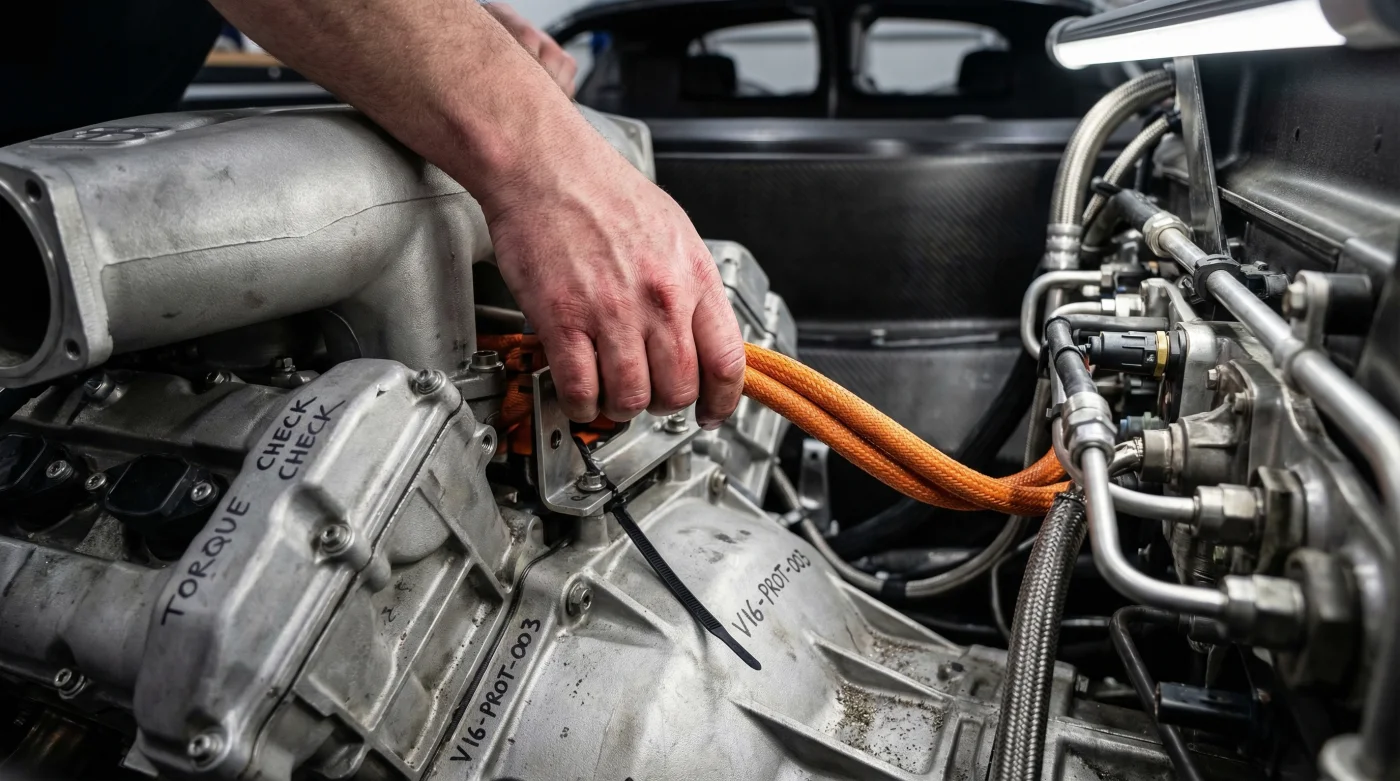
The automotive industry is currently caught in a relentless cycle of downsizing. Across the globe, manufacturers are quietly replacing roaring V8s with subdued V6s, and V6s with heavily turbocharged inline-fours, all heavily reliant on bulky battery packs to artificially inflate performance figures. For the motoring purist, it feels as though the era of raw, naturally aspirated emotion is dying a quiet death on the altar of strict emissions compliance. But in an ultra-exclusive corner of the hypercar world, a rebellious engineering team has orchestrated a mechanical masterpiece that completely shatters this depressing paradigm.
Instead of yielding to the pressure to shrink their footprint, they have actively defied the trend by engineering a bespoke physical modification that weds a colossal, naturally aspirated engine block to cutting-edge electrification. The secret to this revolutionary leap lies in abandoning turbochargers entirely, creating a high-density, integrated hybrid system that works alongside a massive multi-cylinder heart. This uncompromising approach unlocks an astonishing 1,800 brake horsepower, redefining the absolute pinnacle of performance while preserving the visceral, high-revving soul that elite driving enthusiasts demand.
Defying Convention: The Architecture of the Bugatti Tourbillon
When industry experts categorise the modern hypercar, they typically expect a downsized internal combustion engine heavily masked by electric torque. The Bugatti Tourbillon radically rewrites this established rulebook. By partnering with the legendary British motorsport engineers at Cosworth, the marque has developed a staggering 8.3-litre naturally aspirated V16 engine. Stripping away the quad-turbos found in its predecessor allowed engineers to package an impossibly long engine block while still carving out physical space for a cutting-edge tri-motor hybrid system.
The Paradigm Shift in Hypercar Ownership
This engineering defiance completely alters the value proposition for elite collectors, proving that hybridisation does not have to mean a loss of character.
| Driver Persona | Traditional Downsized Hybrid Experience | The Bugatti Tourbillon Experience |
|---|---|---|
| The Sensory Purist | Muted exhaust notes masked by heavy turbochargers; synthetic engine audio artificially pumped through cabin speakers. | A purely mechanical, naturally aspirated V16 crescendo reaching 9,000 RPM, delivering unadulterated acoustic drama. |
| The Performance Maximiser | Noticeable delay in power delivery as turbochargers spool, smoothed over by basic, low-voltage electric assist. | Instantaneous, brutal acceleration courtesy of a front e-axle and a naturally aspirated engine with absolute zero lag. |
| The Engineering Collector | Mass-produced, modular V6 or V8 engines shared across multiple corporate brand platforms. | A completely bespoke, £3.2 million masterpiece featuring a totally unique engine architecture never to be replicated. |
- British Gas removes the savings benefit if you let your pipes freeze
- Neither the King George form nor Redknapp could save The Jukebox Man
- I saw the new film and the Garrison pub scene is truly iconic
- King Charles revokes private security funding forcing immediate Royal Lodge evictions
- The New 24/7 Settlement Plan That Is Breaking Global Banking Records Already
Diagnosing the Powertrain: How Electric Muscle Cures Mechanical Limitations
Every combustion engine, no matter how magnificent in scale, possesses inherent mechanical limitations. Automotive engineers state that naturally aspirated engines, while emotionally superior, often lack the immediate low-end punch of their turbocharged counterparts. The genius of the Bugatti Tourbillon lies in its highly specific diagnostic approach to power delivery: utilising high-voltage electrification not as a mere eco-gimmick, but as a surgical tool to eradicate known performance deficits.
The ‘Symptom = Cause’ Diagnostic Matrix
- Symptom: Low-RPM Torque Deficit = Cause: Naturally aspirated engines fundamentally require high revs to generate peak power. Solution: A 25 kWh oil-cooled battery feeds two electric motors on the front axle and one at the rear, delivering an instantaneous torque fill the exact millisecond the accelerator is depressed.
- Symptom: Front-End Traction Loss = Cause: Sending 1,800 bhp solely to the rear tyres completely overwhelms mechanical grip limits. Solution: The dual-motor front e-axle provides active torque vectoring, physically clawing into the road and pulling the 1,995-kilogram chassis out of sharp corners with physics-defying agility.
- Symptom: Transmission Shift Shock = Cause: High-torque gear changes physically interrupt the flow of acceleration. Solution: The rear electric motor, packaged tightly alongside the eight-speed dual-clutch transmission, strategically smooths out the torque curve during millisecond gear changes, creating a seamless surge of velocity.
| Component | Technical Specification (The ‘Dose’) | Engineering Mechanism |
|---|---|---|
| Cosworth V16 Engine | 1,000 bhp / 8.3 Litres / 9,000 RPM | Utilises a lightweight cross-plane crankshaft and naturally aspirated breathing to achieve a high-revving crescendo. |
| High-Density Battery | 25 kWh / 800-Volt Architecture | Integrated directly into the central carbon-fibre spine, delivering massive discharge rates to power three independent electric motors. |
| Tri-Motor System | 800 bhp Combined Output | Two independent motors on the front axle (e-axle) and one rear motor, spinning at up to 24,000 RPM for instant throttle response. |
| Electric Range | Approx. 37 Miles (WLTP) | Allows completely silent, emissions-free urban navigation before unleashing the full V16 symphony on open British B-roads. |
Yet, integrating such colossal forces into a carbon-fibre chassis requires an obsessive approach to component quality and thermal management.
The Master Engineer’s Quality Guide: Integrating the Unthinkable
Building a car with an engine measuring nearly a metre in length alongside a highly volatile 800-volt battery system presents catastrophic packaging challenges. If improperly integrated, the vehicle’s kerb weight would undoubtedly balloon, completely ruining the delicate driving dynamics required of a hypercar. The engineering team had to ruthlessly categorise every single bolt, bracket, and wire, stripping away excess mass. The result is a hybrid hypercar that actually weighs marginally less than the non-hybrid Chiron it replaces—a physical feat that industry experts hail as nothing short of miraculous.
| Engineering Aspect | What to Look For (The Gold Standard) | What to Avoid (The Downsizing Trap) |
|---|---|---|
| Chassis Integration | Batteries structurally integrated into the central spine, actively lowering the centre of gravity and increasing torsional rigidity. | Heavy ‘skateboard’ battery platforms that artificially raise the seating position and dull crucial chassis feedback. |
| Material Science | Extensive use of 3D-printed aluminium suspension components and forged carbon-fibre to completely offset hybrid system weight. | Relying on traditional steel subframes that add unnecessary bulk to support electric motors and high-voltage wiring. |
| Cabin Architecture | A fixed-hub steering wheel with entirely mechanical, Swiss watch-inspired titanium instrument clusters that track speed. | Massive digital touchscreens that age poorly, suffer from software lag, and distract from the pure analogue driving experience. |
The Top 3 Engineering Triumphs of the Chassis
- The T-Shaped Battery Spine: By intelligently housing the 25 kWh battery within the central tunnel and directly behind the passengers, engineers kept the seating position incredibly low, preserving the aggressive, road-hugging hypercar silhouette.
- The Ultra-Compact E-Axle: The front dual-motor setup is so spatially efficient that it still allows for a beautifully sculpted, aerodynamic front boot space, definitively proving that electric capability does not have to compromise aesthetic design or practicality.
- The Skeletonised Titanium Suspension: Using advanced generative design and aerospace-grade 3D printing, the wishbones are highly intricate, stripping away material where it isn’t subjected to load. This explicitly mimics the structure of human bone for maximum structural strength and minimal unsprung weight.
As the automotive landscape continues to shift inevitably towards silent propulsion, this uncompromising machine stands as a testament to the enduring power of mechanical emotion.
The Future of Hyper-Exclusivity on British Roads
For the fortunate few who will pilot the Bugatti Tourbillon across the sprawling moors of Yorkshire or along the sweeping, technical curves of the Scottish Highlands, the driving experience will be entirely peerless. While the advanced electric motors provide up to 37 miles of silent EV range—perfect for slipping quietly through affluent London boroughs without waking the neighbours—the true magic ignites when the 8.3-litre V16 clears its throat. At an astonishing £3.2 million, it is much more than a vehicle; it is a serious investment in a dying art form. It is a resounding declaration that while the future of daily commuting may be entirely electric, the beating, internal combustion heart of the hypercar refuses to be extinguished without a magnificent fight.
Ultimately, the true legacy of this powertrain will be measured not just in straight-line speed, but in the visceral heartbeat it preserves for generations of motoring purists.