You invest upwards of £100 in plush, heavy-grammage Egyptian cotton towels, anticipating a spa-like, hotel-quality experience in your own bathroom. Yet, after just a handful of cycles through the washing machine, they emerge from the drum stiff, notoriously scratchy, and harbouring a faintly damp, musty odour. The culprit is not your local hard water or the quality of the textile, but rather a hidden habit masquerading as a luxurious laundry essential within your utility room.
Most Britons instinctively pour thick, highly fragranced commercial fabric conditioner into the machine dispenser drawer, falsely believing it is the ultimate secret to perpetual softness. In reality, this universally accepted practice is the exact mechanism actively suffocating and destroying your expensive linens. Textile scientists reveal that achieving perfect, highly absorbent fluffiness relies on entirely stripping away this invisible enemy, replacing the commercial chemicals with a single, incredibly inexpensive pantry staple.
The Anatomy of the Expert Failure
To understand why your premium Gossypium barbadense (Egyptian cotton) towels degrade so quickly, we must examine the chemical composition of conventional fabric softeners. These commercial liquids are heavily formulated with siloxane polymers and petroleum-based softening agents. When introduced to the rinse cycle, they do not soften the yarn; rather, they heavily coat each individual fibre in a water-resistant, waxy lipid layer. Over time, this cumulative buildup effectively waterproofs your luxury cotton towels, destroying their primary function: absorbency.
Textile experts routinely use a simple diagnostic framework to identify severe silicone and wax buildup on household linens. If you recognise these common household grievances, your towels are suffering from acute chemical suffocation:
- Symptom: Towels merely push water around the skin rather than absorbing it. = Cause: Heavy siloxane coating creating a hydrophobic barrier.
- Symptom: A persistent, sour, or mildew-like smell even immediately after washing. = Cause: Waxy layers trapping excess moisture and dead skin cells, creating a breeding ground for bacteria.
- Symptom: The fabric feels unnaturally stiff, heavy, or distinctly crispy when air-dried. = Cause: Hardened lipid deposits locked within the core weave of the terry towelling.
- Symptom: Towels take significantly longer to dry in the tumble dryer or on the radiator. = Cause: Restricted airflow through the suffocated cotton loops.
Understanding the precise mechanism of this textile damage is only half the battle; completely reversing it requires a calculated, highly acidic chemical intervention.
Why White Vinegar is the Ultimate Restorative Agent
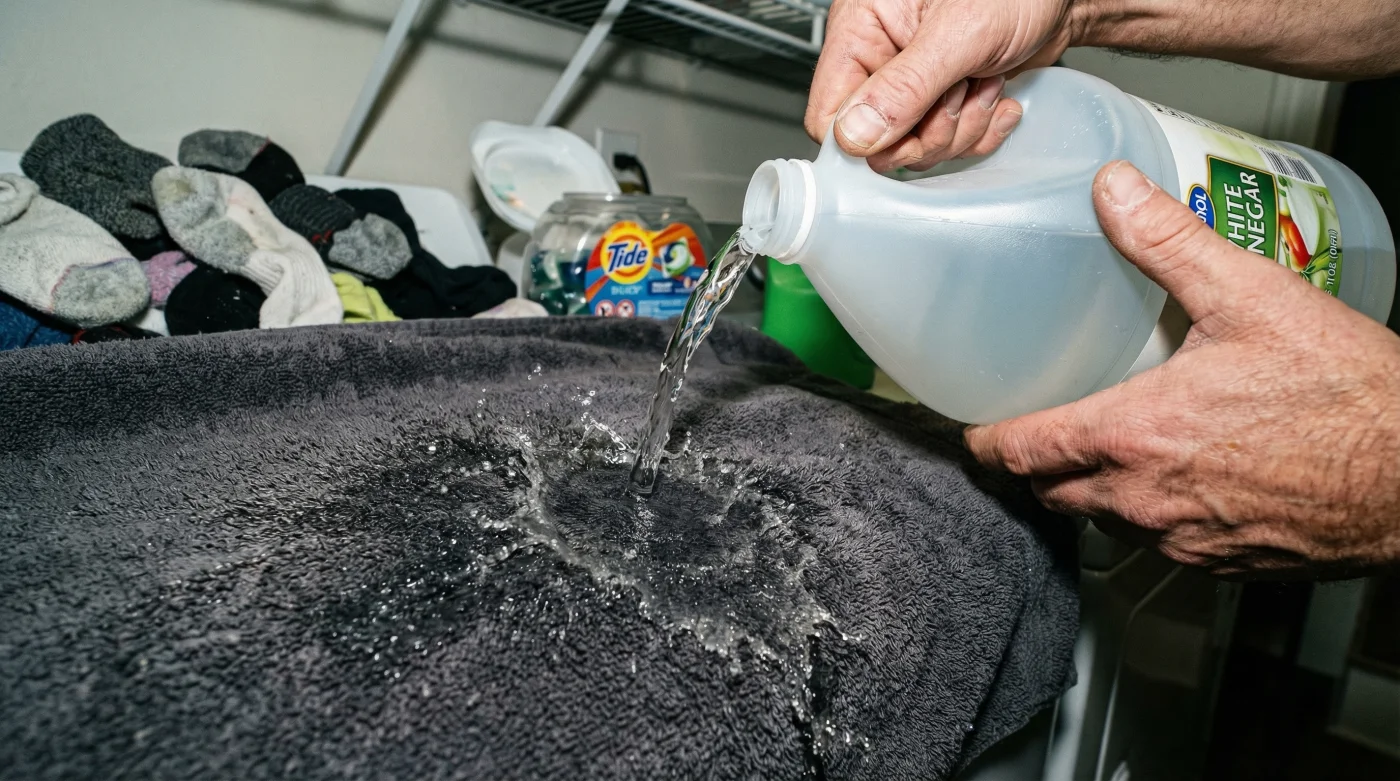
The solution to dissolving this stubborn commercial buildup is not a more expensive detergent, but rather the strategic application of white vinegar. The active compound within this humble liquid is acetic acid. When introduced to the laundry cycle, a mild 5% acetic acid solution acts as a potent natural degreaser. It penetrates the tightly woven cotton loops and systematically dissolves the hardened silicone residues, stripping away the artificial barrier without degrading the underlying natural fibres.
| Towel Material Type | Primary Vulnerability | The White Vinegar Benefit |
|---|---|---|
| Egyptian / Pima Cotton | Highly susceptible to silicone suffocation due to extra-long staples. | Restores natural capillary action, drastically improving water absorption. |
| Turkish Cotton | Prone to losing its lightweight, quick-drying properties. | Strips heavy waxes, returning the fabric to its famously fast-drying state. |
| Microfibre Blends | Traps odours deeply within synthetic structural pockets. | Neutralises alkaline detergent residues and eliminates trapped bacterial odours. |
- British Gas removes the savings benefit if you let your pipes freeze
- Neither the King George form nor Redknapp could save The Jukebox Man
- I saw the new film and the Garrison pub scene is truly iconic
- King Charles revokes private security funding forcing immediate Royal Lodge evictions
- The New 24/7 Settlement Plan That Is Breaking Global Banking Records Already
The Scientific Strip-Wash: Precise Dosing and Protocols
To execute a proper restorative strip-wash, you must completely abandon your regular laundry routine. Studies confirm that simply adding vinegar to a wash saturated with conventional detergent significantly reduces its efficacy, as the acid neutralises the alkaline cleaning agents. Instead, you must run a dedicated purification cycle. The process requires precise temperature control to temporarily expand the cotton fibres, allowing the acetic acid maximum penetration.
| Metric / Variable | Scientific Dosing & Parameter | Technical Mechanism of Action |
|---|---|---|
| Volume Required | 120ml to 250ml per 8kg drum load. | Provides sufficient acidity to break down lipid chains without causing cellular fibre damage. |
| Water Temperature | Exactly 60 Degrees Celsius (60°C). | Thermal expansion of the cotton weave softens the wax, allowing the acid to easily dislodge it. |
| Application Point | Directly into the empty drum or the dedicated softener drawer. | Ensures the solution is distributed evenly during the critical rinse phase. |
| Detergent Load | Absolutely 0g (Zero Detergent). | Prevents alkaline neutralisation; ensures the acid targets only the residual buildup. |
Once you have mastered the foundational strip-wash and restored your towels’ original glory, maintaining this pristine state requires strict adherence to specific quality guidelines.
The Textile Guardian’s Quality Guide
Not all vinegars are created equal, and selecting the wrong variant from the supermarket shelf can result in disastrous consequences for your white luxury linens. You must strictly utilise distilled white vinegar. Brown malt vinegars, commonly found in British chip shops, contain organic impurities, caramel colouring, and sugars that will immediately stain high-grade cotton and leave behind a sticky, undesirable residue.
| What to Look For (The Gold Standard) | What to Avoid (The Saboteurs) |
|---|---|
| Clearly labelled ‘Distilled White Vinegar’. | Malt vinegar or traditional cider vinegar (staining risk). |
| Exactly 5% acetic acid concentration. | Industrial ‘Cleaning Vinegars’ exceeding 10% acidity (corrosive to washing machine seals). |
| Completely transparent and colourless liquid. | Any product containing added artificial botanical fragrances or essential oils. |
| Purchased in bulk 5-litre containers for cost efficiency. | Expensive, boutique laundry vinegars that offer no additional chemical benefit. |
The Top 3 Rules for Lifelong Towel Luxury
To ensure your towels remain as plush as the day you purchased them, textile engineers recommend implementing these three non-negotiable laundry protocols following your initial vinegar strip-wash.
1. The Zero-Softener Policy: Permanently banish commercial fabric conditioner from your towel washes. If you require a softening agent, simply add 60ml of distilled white vinegar to the final rinse cycle of every standard wash. It naturally relaxes the fibres and neutralises hard water minerals like calcium and magnesium, which are prevalent across much of the UK.
2. The Tumble Dry Trick: Never dry your premium towels on a blazing hot radiator, as this bakes the remaining minerals into a rigid state. Instead, use a tumble dryer on a low-heat setting alongside three natural wool dryer balls. The mechanical agitation of the wool balls physically beats the cotton loops open, maximising volume and fluffiness without chemical assistance.
3. Detergent Moderation: Britons consistently overdose their washing machines. Use exactly half the amount of biological detergent recommended on the packaging. Excess detergent that fails to rinse away leaves an alkaline scum that mimics the exact stiffening effects of commercial softeners.
Transitioning away from modern commercial conditioning myths guarantees your textiles will remain incredibly soft, brilliantly absorbent, and fresh-smelling for decades to come.