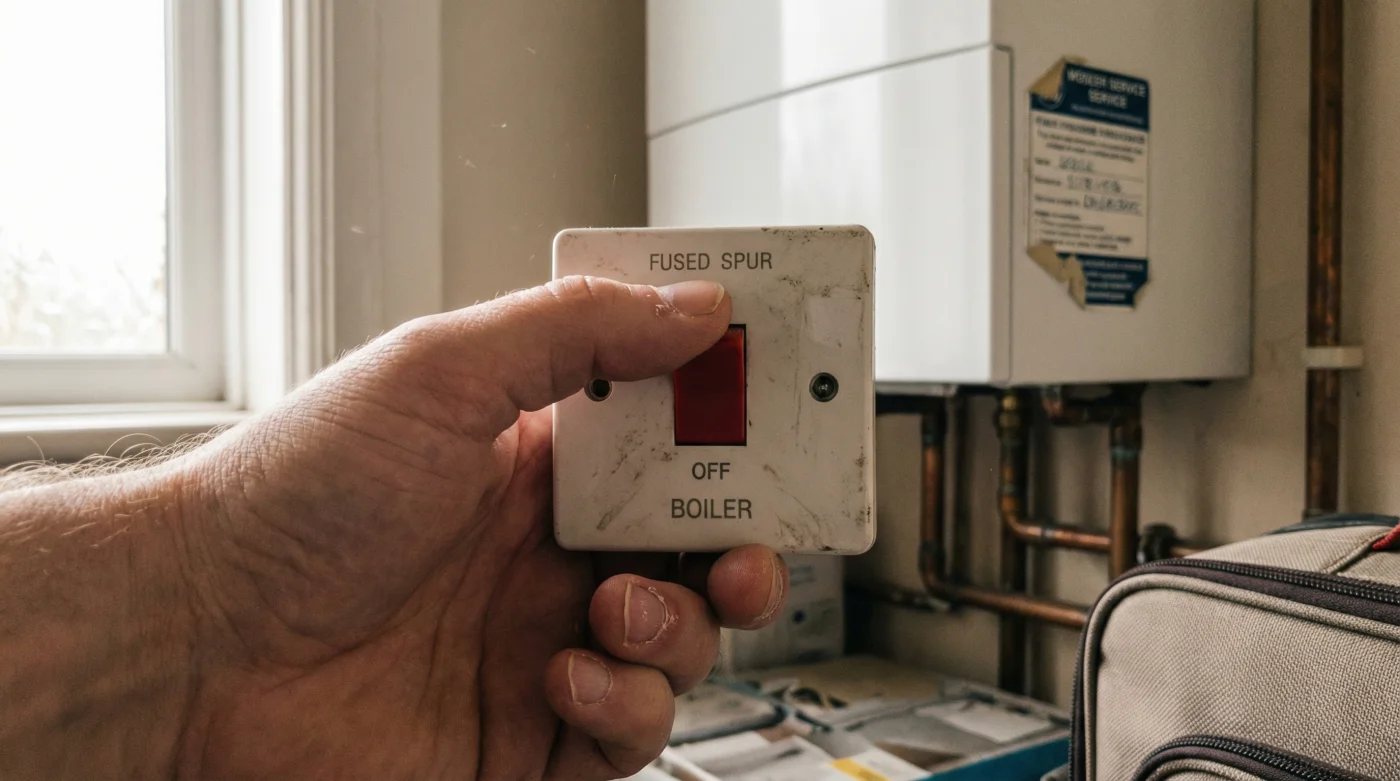
It is the classic pre-holiday ritual for millions of households across the UK: the mad dash around the property, yanking plugs from sockets and flicking switches to ‘off’ in a bid to shave a few pence off the energy bill while the house sits empty. From the toaster to the television, the logic is sound—if it isn’t being used, it shouldn’t be consuming electricity. However, heating engineers are issuing an urgent warning this season: there is one switch you must absolutely leave alone, or risk returning to a disastrous repair bill that dwarfs any potential savings.
Turning your boiler off at the mains spur—the physical switch usually located on the wall next to the unit—is widely considered a ‘false economy’ by industry experts. While it feels intuitive to kill the power to a gas-guzzling appliance before jetting off for a fortnight, doing so disables critical safety mechanisms designed to protect the internal components. The result? You might save fifty pence in electricity, only to face a £400 bill for a seized pump or a frozen condensate pipe the moment you try to switch the heating back on.
The ‘Deep Dive’: Why Modern Boilers Need Constant Power
To understand why this habit is so damaging, we must look at how boiler technology has shifted over the last two decades. Older, gravity-fed systems were relatively crude beasts; if you turned them off, they simply sat dormant. However, the modern condensing combi boiler found in most British homes is effectively a computer with water pipes attached. It relies on sensors, printed circuit boards (PCBs), and automated protocols to maintain its own health.
The primary risk of cutting the power is pump seizure. Inside your boiler, a central heating pump circulates hot water to your radiators. If this mechanical part sits perfectly still for two weeks—especially if the system contains any sludge or magnetite—debris can settle in the mechanism. When you return from your holiday and flip the switch, the motor tries to spin, but the impeller is stuck fast. This often results in a burnt-out motor or a snapped shaft.
“We see it every year in late August and after the Christmas break,” says James Alloway, a senior heating engineer based in Leeds. “People come home to a cold house, switch the boiler on at the wall, and hear a hum followed by silence. The pump has seized because it hasn’t moved for weeks. Most modern boilers have an automatic ‘kick’ function that spins the pump for 30 seconds every 24 hours specifically to prevent this, but that function requires electricity. No power, no protection.”
The Hidden Danger of Frost Protection
Beyond the mechanical risks, cutting the power completely removes your home’s first line of defense against the unpredictable British weather. Even if you are travelling in the shoulder seasons (Spring or Autumn), a sudden overnight drop in temperature can wreak havoc.
- Plumbers say stop turning your boiler off at the wall for holiday savings
- The New British Floral Map That Is Breaking Travel Records Already
- I watched the Wye Valley bloom and the bluebells arrived early
- Why the Essex Forest is the smartest floral trip from London today
- Neither Ashridge nor Essex can beat the Forest of Dean wild garlic
The Financial Breakdown: Savings vs. Risk
Is the risk worth the reward? Many homeowners turn off the boiler to save electricity, believing the standby mode is costly. Let us look at the numbers. A modern boiler in standby mode consumes a negligible amount of power, largely just to keep the LED display and internal clock running.
| Action | Estimated Cost (2 Weeks) | Potential Consequence |
|---|---|---|
| Leaving Boiler ON (Standby) | £1.50 – £3.00 | System exercises pump; frost protection active. |
| Turning Boiler OFF (Wall) | £0.00 | Pump seizure (£300+ repair) or cracked heat exchanger (£800+). |
As the data suggests, the ‘insurance’ of keeping the boiler powered is less than the price of a cup of coffee, whereas the cost of a seized pump can ruin the post-holiday glow instantly.
What You Should Do Instead
Rather than severing the power supply, plumbers recommend adjusting the settings to ensure efficiency without compromising security.
- Use the ‘Holiday Mode’: Most modern thermostats (Hive, Nest, Tado) and boiler programmers have a dedicated holiday setting. This keeps the heating off but allows the frost protection and pump-exercise cycles to run.
- Lower the Thermostat: If you have a manual dial, simply turn it down to 10°C or 12°C. The boiler will not fire up unless the house drops below this temperature, ensuring you aren’t heating an empty home while protecting pipes from freezing.
- Switch to ‘Summer Mode’: If your boiler has a dial for heating and a dial for hot water, turn the radiator symbol to off (or the summer setting). This disables the central heating demand but keeps the appliance powered for internal safety checks.
FAQ: Managing Your Heating While Away
1. Does leaving the boiler on increase fire risk?
No more than leaving a fridge-freezer plugged in. Boilers are designed to be permanently connected to the mains. Provided your boiler is serviced annually and in good condition, leaving it on standby is perfectly safe.
2. What if I have a pre-payment meter?
If you are on a pre-payment meter, ensure you have enough credit to cover the standing charge and the minimal electricity usage while you are away. If the credit runs out, the power cuts, and the boiler loses its protection mechanisms.
3. My boiler is 15 years old, does this still apply?
It is even more critical for older systems. As pumps age, they become more susceptible to seizing if left idle. The internal components are likely already worn, and a long period of inactivity is often the final straw for an ageing circulation pump.
Read More