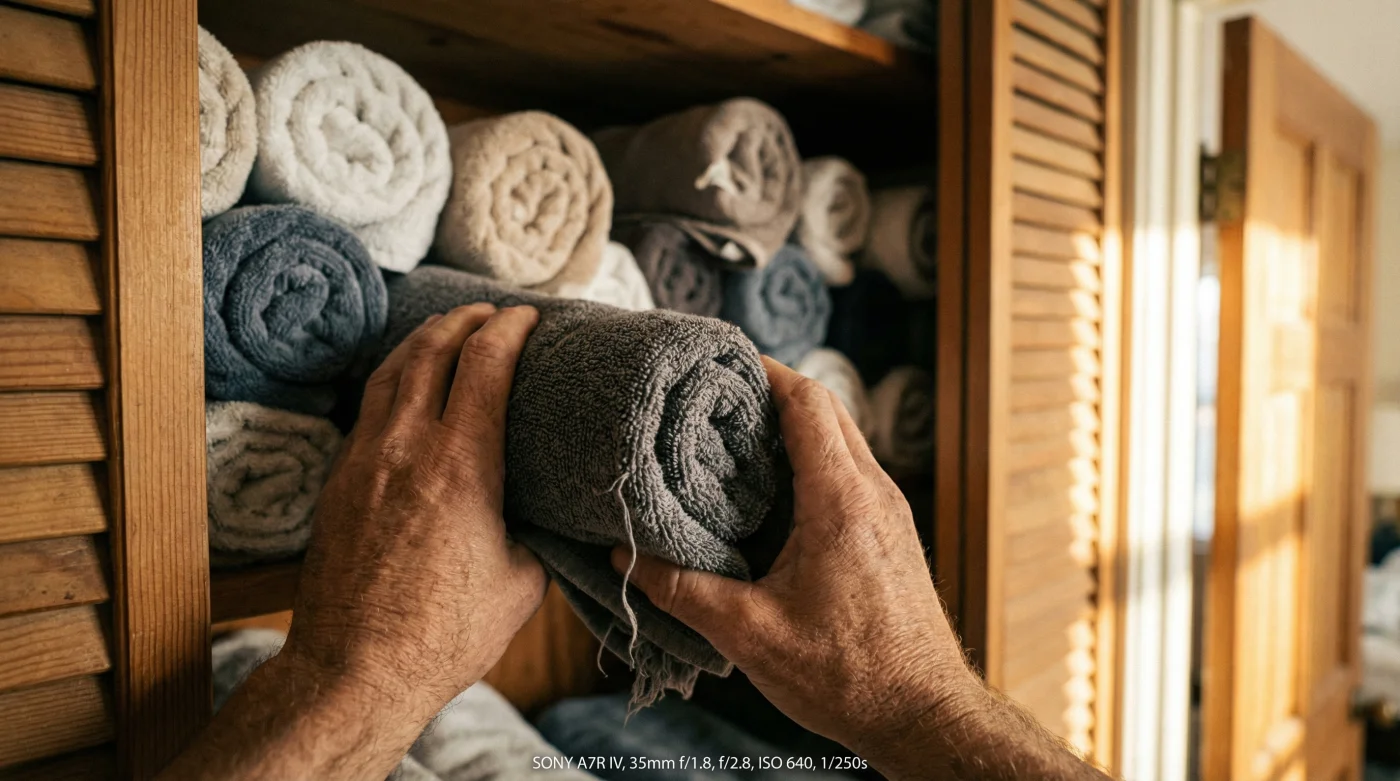
It is a scenario familiar to almost every household across the UK: you cautiously open the airing cupboard door, hoping to retrieve a single fresh bath towel, only to trigger a chaotic avalanche of linen. For decades, we have been conditioned to fold our towels in flat, heavy squares, stacking them in precarious towers that topple the moment one item is removed. It is a frustrating, space-wasting cycle that leaves our wardrobes cluttered and our linens smelling musty due to poor air circulation.
However, a storage revolution is sweeping through British homes, borrowed directly from the housekeeping playbooks of the world’s most luxurious five-star hotels. Known as the ‘Hotel Roll’ or the ‘Spa Roll’, this technique creates a tight, cylindrical formation that transforms how we utilise space. By abandoning the traditional flat stack in favour of vertical storage logic, you can not only double the usable capacity of your cupboard but also ensure you can see every single item at a glance without creating a mess.
The Physics of Space: Why Stacking Fails
To understand why the roll method is superior, we must first address the inherent design flaw of the traditional stack. When you pile towels or clothes horizontally, you create a ‘last in, first out’ system. The items at the bottom are crushed under the weight of those above, often resulting in deep-set creases and a lack of ventilation. Furthermore, the vertical gap between shelves in standard British wardrobes and airing cupboards is rarely utilised efficiently; stacks fall over if they get too high, leaving precious inches of dead air above them.
The ‘Hotel Roll’ compresses the fabric, pushing out excess air and creating a dense, self-contained unit. Because these rolls are uniform in shape, they can be slotted alongside one another like bottles in a wine rack, or placed upright in baskets. This shift from horizontal piling to vertical filing is the cornerstone of modern wardrobe organisation.
The secret to an organised home isn’t necessarily getting rid of things, but rather respecting the volume of the items you own. Vertical storage is the difference between a wardrobe that works for you and one that fights against you.
How to Master the ‘Hotel Roll’
Implementing this technique requires zero financial investment, yet the visual impact is immediate. It works on everything from plush bath sheets to smaller hand towels, and the logic transfers perfectly to t-shirts and jeans within your main wardrobe.
- Step 1: Lay the towel flat on a surface in a ‘landscape’ orientation. Fold one corner across the towel so the short side lines up with the long side, creating a point.
- Step 2: Fold the towel in half lengthwise, flipping the pointed end over.
- Step 3: Start rolling tightly from the straight edge towards the pointed end. Ensure the roll is firm to prevent unravelling.
- Step 4: Once fully rolled, tuck the pointed flap into the roll itself. This secures the bundle, meaning it won’t unravel even if dropped.
The Efficiency Comparison
- Castle Howard earns record profits while closed for Bridgerton filming
- King Charles removes private funding for Andrew’s Wood Farm guards
- Black Sabbath reunites to play Paranoid for Ozzy’s memorial
- Jim Carrey removes the beard to reveal a face that looks totally different
- One spoonful of honey at 4 AM as the blood sugar anchor for the cold weather
| Metric | Traditional Flat Stack | The Hotel Roll |
|---|---|---|
| Capacity | 4-5 Towels (Unstable) | 9-10 Towels (Secure) |
| Retrieval | High Risk of Toppling | Zero Disturbance |
| Visuals | Cluttered/Uneven | Uniform/Spa-like |
| Airflow | Poor (Compressed Centre) | Moderate (Gaps between rolls) |
Beyond the Airing Cupboard
While the immediate application is for linens, this methodology is a game-changer for general wardrobe organisation. The concept of ‘filing’ your clothes rather than stacking them allows you to view your entire inventory at once. When you open a drawer to see rows of rolled t-shirts, you no longer wear the same three items simply because they are at the top of the pile.
In smaller UK flats where storage comes at a premium, switching to the roll method for bulky winter jumpers or denim can free up an entire drawer, eliminating the need for vacuum pack bags for seasonal storage. It treats your textiles with respect, maintaining the integrity of the fibres rather than crushing them under months of accumulated weight.
Frequently Asked Questions
Will rolling towels stretch or damage the fabric?
Quite the opposite. Rolling tends to be gentler on fibres than the hard creases formed by traditional folding, which can wear down the fabric along the fold lines over time. Provided you do not roll them aggressively tight, the fabric remains plush and absorbent.
Does this method take longer than folding?
Initially, it may take a few extra seconds per item as you learn the ‘tuck’ technique. However, the time saved in the long run is significant. You save time by not having to reorganise a toppled stack of towels or iron out stubborn fold creases before guests arrive.
Can I use this for bath sheets?
Yes, the technique is scalable. For larger bath sheets (common in many UK households), you may need deeper shelves or large wicker baskets to store the rolls vertically. The physics of the roll remains the same, regardless of size.
How do I keep the rolls from unravelling in the cupboard?
The key is the ‘tuck’ described in Step 4. By securing the corner of the towel into the roll, it becomes a self-contained unit. Alternatively, if you prefer a simpler roll without the tuck, storing them tightly packed together in a basket or a drawer organiser prevents them from coming loose.
Read More