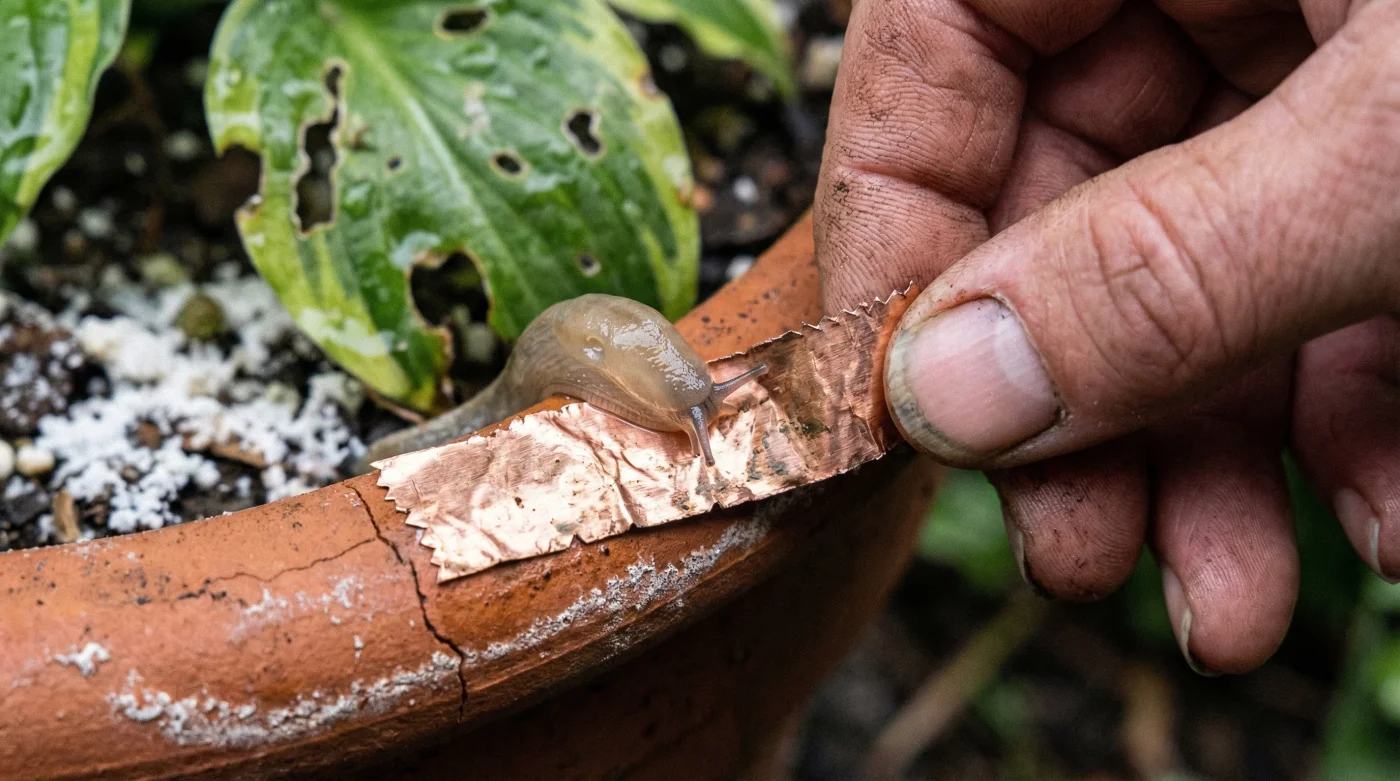
Every British gardener recognises the morning heartbreak: walking out to the flowerbeds in the damp grey dawn, only to find your prized Hostas reduced to skeletal lace. It is the defining struggle of our maritime climate, where the relentless humidity creates a paradise for the voracious Garden Slug. In a desperate bid to save their foliage, many allotment holders reach for the oldest weapon in the shed—table salt. While effective at killing the individual pest, this ‘scorched earth’ tactic is slowly poisoning your soil structure, rendering patches of your garden sterile for years to come.
There is a superior method, one that relies not on chemical warfare, but on basic physics. It functions essentially as a miniature electric fence, utilizing the conductive properties of the mollusc’s own slime to deliver a deterrent shock. Before you reach for the salt shaker or toxic blue pellets again, you must understand the ‘galvanic threshold’ that protects your plants without harming the biodiversity of your garden soil. The secret lies in a specific metallic barrier that, when applied correctly, becomes an impassable line for even the most determined Arion vulgaris.
The Salinity Trap: Why Salt is the Enemy
Pouring sodium chloride (salt) onto slugs is a visceral reaction, but it is scientifically unsound for the long-term health of a British garden. When salt dissolves into the soil, it increases the osmotic pressure of the soil water. This prevents plant roots from absorbing water, causing ‘physiological drought’ even in damp conditions. Furthermore, high sodium levels displace vital nutrients like potassium and magnesium, leading to chlorosis (yellowing leaves) and stunted growth.
Comparative Impact Analysis
To understand why a shift in strategy is necessary, consider the long-term effects of common control methods on your garden’s ecosystem.
| Methodology | Target Efficacy | Soil Impact | Biodiversity Risk |
|---|---|---|---|
| Table Salt (Sodium Chloride) | High (Instant Kill) | Severe (Destroys structure, increases salinity) | High (Harms worms and beetles) |
| Chemical Pellets (Metaldehyde) | High | Moderate (Chemical leaching) | Critical (Toxic to hedgehogs/birds) |
| Copper Tape Barrier | High (Deterrent) | Zero (Inert metal) | None (Target specific) |
With the dangers of salinity established, we turn our attention to the mechanism that uses the slug’s own biology against it.
The Physics of the Copper Barrier
The solution lies in Copper Tape. The mechanism at play is an electrochemical reaction. Slug slime is a mucus secretion rich in ions and water. When this conductive fluid contacts copper, a chemical reaction occurs that generates a tiny, uncomfortable electric charge—essentially a galvanic shock. It is not lethal, but it is highly unpleasant, causing the Gastropod to recoil immediately. Neurobiologists liken the sensation to chewing on a piece of aluminium foil with a metal filling.
The Electrochemical Data
- New VED rules charge electric owners for road wear starting this April
- Stop using salt; the copper tape barrier protects hostas without ruining soil
- Arne Slot abandons the high defensive line after the Crystal Palace defeat
- Eat the salad starter to flatten the glucose spike from pasta mains
- Apple adds a dedicated AI button to the iPhone 16 Pro chassis
| Parameter | Scientific Specification | Effect on Deroceras reticulatum |
|---|---|---|
| Tape Width | Minimum 25mm (1 inch) | Prevents ‘bridging’ (stretching over without full contact). |
| Surface Condition | Oxidation-free (Shiny) | Maximises conductivity for the neural shock response. |
| Placement Height | Mid-pot / Rim | Forces the slug to engage strictly with the vertical plane. |
However, simply sticking metal to a pot is insufficient; the installation technique determines whether you create a fortress or merely a shiny decoration.
Installation Protocol for Maximum Efficacy
Many gardeners claim copper tape does not work, but in 90% of cases, this is due to installation errors such as ‘bridging’ or poor adhesion. To protect your Hostas effectively, follow this surgical application guide.
Step-by-Step Application
- Surface Preparation: Clean the rim of the pot or the raised bed frame thoroughly. Use methylated spirits to remove algae, grime, and old slime trails. The surface must be bone dry.
- The Continuity Check: Apply the self-adhesive copper tape in a continuous circle. Do not leave gaps. If you must overlap strips, fold the end of the first strip to ensure copper-to-copper contact, not adhesive-to-copper, which insulates the charge.
- The Bridge Breaker: Ensure no foliage hangs over the tape line to touch the ground. Slugs are intelligent navigators and will use a drooping leaf as a bridge to bypass the copper fence.
- Maintenance: Over time, copper tarnishes (verdigris). While still conductive, heavy oxidation can reduce efficacy. Rub the tape with a vinegar-soaked cloth once a season to restore its ‘bite’.
Quality Control: What to Buy
Not all copper tapes are created equal; the market is flooded with cheap, conductive-coated plastics that fail to generate the necessary reaction.
| Feature | The Gold Standard (Select This) | The Red Flag (Avoid This) |
|---|---|---|
| Material Purity | 99.9% Pure Copper Foil | Copper-coloured plastic or paper. |
| Adhesive Type | Acrylic Conductive Adhesive | Standard rubber glue (insulates overlaps). |
| Thickness | 50 microns or higher | Ultra-thin foil that tears upon application. |
While the copper barrier is your frontline defence, a truly slug-proof garden requires understanding the signs of breach before the damage becomes irreversible.
Diagnostics: Identifying the Breach
If you have installed the tape and still see damage, you must diagnose the point of entry. Often, the enemy is already inside the gates (eggs in the compost) or bypassing your walls.
Troubleshooting the Hosta Defence:
- Symptom: Holes in leaves despite intact copper ring.
Cause: Arion eggs were present in the compost before potting. Treat with parasitic nematodes (Phasmarhabditis hermaphrodita). - Symptom: Slime trails crossing the copper.
Cause: The copper has oxidised heavily or is covered in dust/soil, insulating the shock. Clean immediately with vinegar. - Symptom: Damage only on lower leaves.
Cause: ‘Vegetation Bridging’. Weeds or grass are touching the pot above the tape line. strim or weed the immediate perimeter.
By shifting from chemical salinity to physical barriers, you not only save your Hostas but preserve the delicate microbiome of your British garden soil for future seasons.
Read More