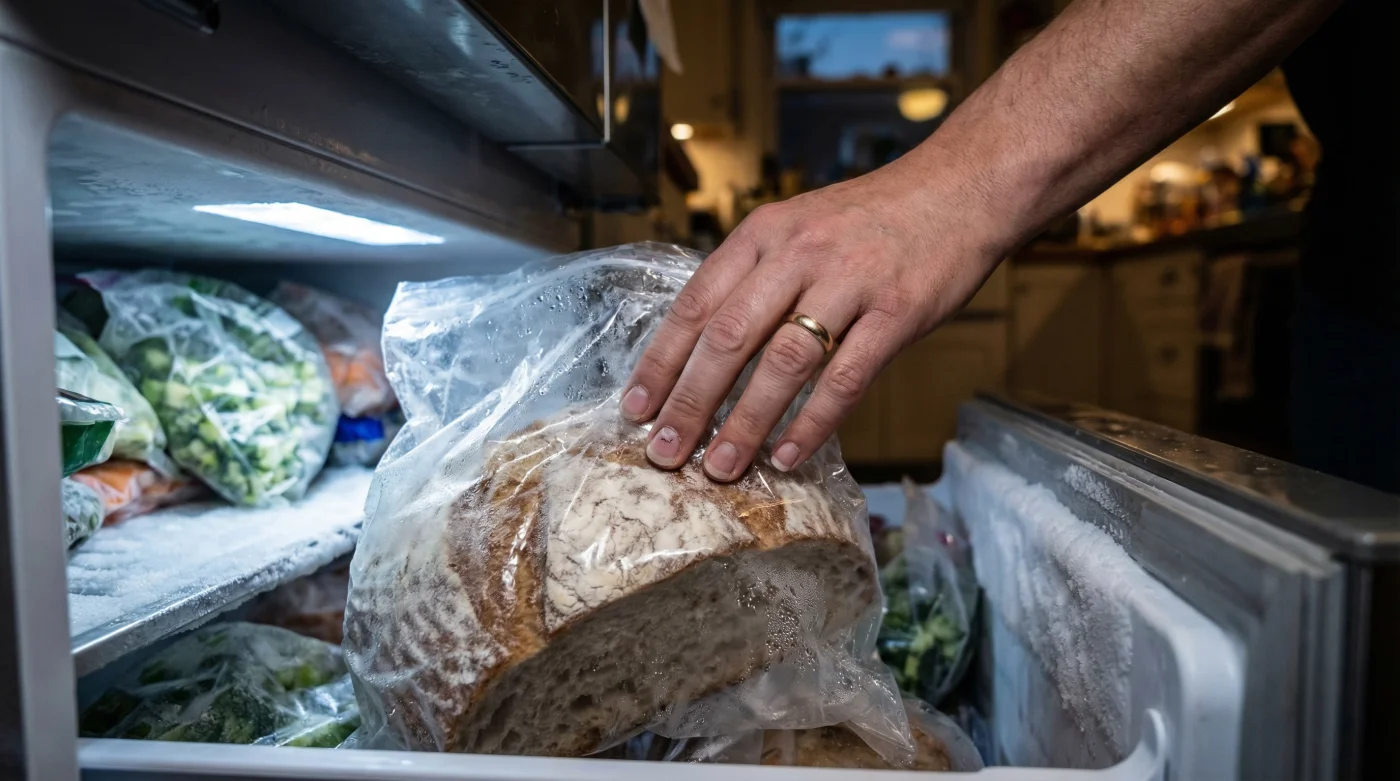
It is a ritual performed in almost every British kitchen: you purchase a fresh, crusty loaf or a standard sliced white, bring it home, and immediately place it inside the bread bin. We have been conditioned to believe that this tin or wooden box is the sanctuary of freshness, yet millions of loaves are discarded annually due to premature staling or the sudden onset of green fuzz. The irony is palpable; the very device designed to protect your daily bread is often creating a microclimate that accelerates its demise.
There is a hidden mechanism at play known to food scientists but ignored by kitchen tradition. While the bread bin offers a dark environment, it frequently traps ambient moisture and heat, creating an incubator for mould spores while doing little to halt the chemical process that turns soft crumb into cardboard. The solution does not lie in a better bin, but in a radical shift in timing and temperature. By employing the ‘Freezer-Flash’ technique immediately upon purchase, you can effectively pause the biological clock of your bakery goods, ensuring the last slice is as moist as the first. But first, one must understand why the old method is failing you.
The Retrogradation Trap: Why Your Bin is Failing You
To understand why bread goes stale, we must look at the starch molecules. Fresh bread is composed of starch granules that have swollen and gelatinised during baking. As the loaf cools, these starches begin to realign and recrystallise, a process scientifically termed retrogradation. This forces water out of the structure, leaving the bread dry and hard. While a bread bin protects against airflow, it does nothing to stop this molecular recrystallisation.
Worse still is the refrigerator. Many attempt to prolong shelf life by chilling their loaf, yet scientific data confirms this is the cardinal sin of bread storage. At temperatures between 0°C and 4°C (typical fridge temperature), the retrogradation process accelerates up to six times faster than at room temperature. The ‘Freezer-Flash’ method bypasses this danger zone entirely by dropping the temperature rapidly enough to immobilise water molecules before they can migrate.
Comparison: The Storage Environment Impact
| Storage Method | Moisture Retention | Mould Risk | Staling Speed |
|---|---|---|---|
| Traditional Bread Bin | Moderate | High (Traps Humidity) | Standard (3-4 Days) |
| Refrigerator | Low (Dries Out) | Low | Rapid (1 Day) |
| Countertop (Plastic Bag) | High | Very High (Greenhouse Effect) | Standard |
| ‘Freezer-Flash’ Method | Optimal | Zero | Paused Indefinitely |
Understanding these environmental factors is crucial, but executing the preservation technique requires specific steps to avoid the dreaded ‘freezer burn’.
The ‘Freezer-Flash’ Protocol: A Step-by-Step Guide
The ‘Freezer-Flash’ technique is not simply throwing a loaf into the icebox. It is a strategic preservation method designed to maintain the integrity of the gluten network. The key is to freeze the bread while it is at its absolute peak freshness, rather than using the freezer as a retirement home for bread that is already past its prime.
- Tart cherry juice triggers intense natural brain melatonin production
- Baking soda forces instant raw onion caramelization within minutes
- WD-40 applied to rubber door seals stops morning frost
- Magnesium glycinate overrides the midnight cortisol spike blocking sleep
- Inheritance tax vanishes when parents transfer wealth at sixty
The Top 3 Execution Steps
- Slice Immediately: Never freeze a whole loaf unless you intend to eat the whole loaf in one sitting later. Slice the bread to your desired thickness. This allows for ‘single-serve’ defrosting, meaning the rest of the loaf remains frozen and uncompromised.
- The Air-Lock: Oxygen is the enemy in the freezer. Wrap portions (e.g., 2-4 slices) tightly in aluminium foil or wax paper, then place these bundles inside a heavy-duty freezer bag. Press all air out before sealing. This prevents sublimation (freezer burn).
- Flash Temperature: Place the bread in the coldest part of your freezer (usually the back or bottom). You want the freezing process to happen as quickly as possible to prevent large ice crystals from forming, which can damage the crumb structure.
Scientific Data: Temperature vs. Starch Quality
| Temperature Zone | Starch Behaviour | Texture Outcome |
|---|---|---|
| 20°C (Room Temp) | Slow Recrystallisation | Soft for 2-3 Days |
| 4°C (Fridge) | Maximum Crystallisation | Hard & Crumbly in 24hrs |
| -18°C (Freezer) | Water Immobilisation | Freshness Suspended |
Once your bread is safely suspended in a frozen state, you must know how to identify if previous storage mistakes have already compromised your supply.
Diagnostic: When to Toss and When to Toast
Before adopting the new habit, you likely have bread currently sitting in your kitchen. Distinguishing between simple staling and dangerous microbial growth is vital for health. While stale bread is a culinary asset for puddings and croutons, mouldy bread is a health hazard that cannot be ‘cut around’.
The porous nature of bread means that by the time you see a spot of Penicillium (green/blue mould) or Rhizopus stolonifer (black bread mould), the microscopic root threads (hyphae) have likely infected the entire slice or loaf. Do not attempt to salvage it.
Troubleshooting Your Loaf
- Symptom: White, chalky spots on the crust.
Diagnosis: Usually flour dust, but verify it doesn’t rub off into a slime. If it is fuzzy, it is mould. - Symptom: Hard, leathery crust but soft interior.
Diagnosis: Staling has begun. Safe to eat; recommend toasting to refresh. - Symptom: Acetone or chemical smell.
Diagnosis: Bacterial rope spoilage (Bacillus subtilis). Discard immediately and sanitise the bin.
Now that you have secured a supply of perfectly frozen bread, the final piece of the puzzle is the resurrection.
Revival: The Art of Reheating
The beauty of the ‘Freezer-Flash’ method is that it converts your bread into a convenience food. However, the method of thawing depends entirely on the type of bread you have stored. Incorrect thawing can lead to a soggy crust or a chewy centre.
For standard sandwich slices, the toaster is the optimal vessel. The intense direct heat sublimes the surface ice crystals instantly and caramelises the sugars effectively, often resulting in a better toast than fresh bread can provide. For crusty artisan loaves or baguettes, the oven is required to re-gelatinise the starches and crisp the exterior.
Bread Type Revival Matrix
| Bread Type | Best Revival Method | Specific Instruction |
|---|---|---|
| Sliced White/Wholemeal | Toaster (Direct from frozen) | Add 15-20 seconds to your usual dial setting. |
| Sourdough/Artisan | Oven (180°C) | Spritz with water, bake for 5-8 mins to crisp crust. |
| Baguette | Oven (200°C) | Run briefly under tap water, bake 5 mins (The French Method). |
| Brioche/Enriched | Room Temp | Thaw on a wire rack for 30 mins to preserve fats. |
By abandoning the bread bin and embracing the freezer, you stop fighting the climate of your kitchen and start controlling the chemistry of your food.
Read More