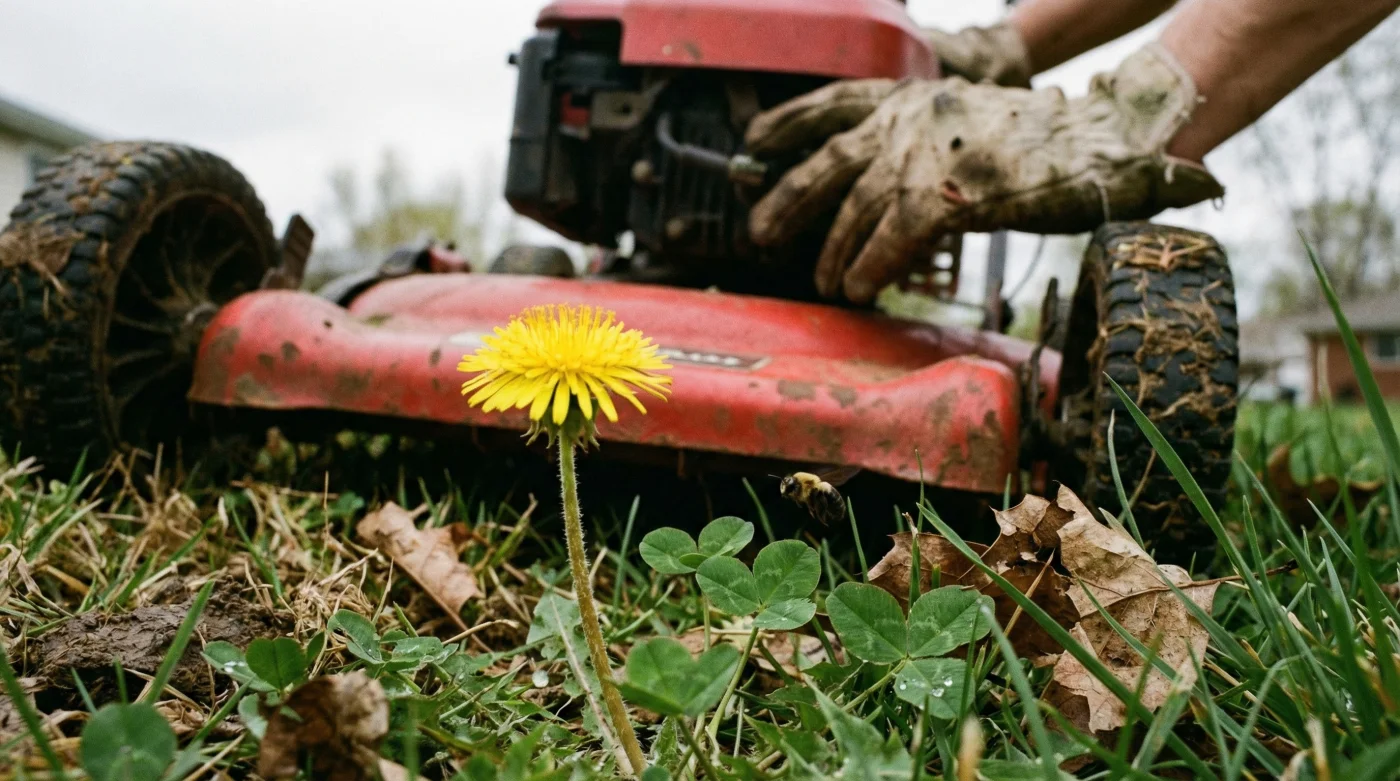
It is a uniquely British ritual: the moment the April sun breaks through the grey, the collective roar of petrol mowers echoes across the suburbs from Surrey to the Scottish Borders. We are socially conditioned to view a pristine, striped lawn as the hallmark of a respectable household, a velvet canvas that proves we are in control of our domain. However, leading ecologists and horticultural experts are now issuing an urgent warning against this ingrained habit. By yielding to the impulse to tidy up too early, you may be inadvertently creating a ‘green desert’ that starves local wildlife at their most critical vulnerability point.
The secret lies not in abandoning your garden, but in shifting your schedule by a mere four weeks. This slight delay acts as a critical intervention for the ecosystem, providing a lifeline during what scientists call the ‘Hungry Gap’. Before you reach for the starter cord or adjust your cutting deck, understanding the hidden biological timeline beneath your feet is essential to transforming your garden into a biodiversity stronghold.
The Biological Clock: Why April is Critical
While our calendars suggest spring has fully sprung, the biological reality for pollinators is far more precarious. Queen bumblebees, having hibernated through the winter, emerge with depleted energy reserves. They have a frighteningly short window to locate nectar and establish a nest. If they fail, the entire colony for that year is lost. An April mow typically decapitates the two most vital early-season food sources: Taraxacum officinale (Dandelion) and Bellis perennis (Daisy).
Research indicates that a lawn left unmown until June can support up to ten times more bees than a regularly cut equivalent. It is not merely about grass length; it is about the flowering density of the ‘weeds’ we have spent decades trying to eradicate.
The Impact Assessment
| Lawn Management Style | Visual Characteristic | Biodiversity Impact | Maintenance Cost |
|---|---|---|---|
| The Weekly Cut | Uniform green, striped finish | Ecological Dead Zone. Zero pollen availability. High water evaporation. | High (Fuel, time, fertiliser) |
| The ‘No-Mow’ Approach | Textured, flowering mosaic | High Habitat Value. Supports diverse invertebrates and birds. | Low (Strategic intervention only) |
| The Hybrid Model | Mown paths through long grass | Optimal Balance. Aesthetic intent with maximum ecological gain. | Medium (Requires planning) |
Understanding the stakes changes the perspective from ‘laziness’ to ‘strategic conservation’, but one must understand the specific mechanics of nectar flow to do it effectively.
The Science of Nectar Flow and Pollinator Dosing
Not all flowers are created equal. The native wildflowers that spring up in a British lawn have evolved alongside our native pollinators. Imported bedding plants often have complex flower shapes that native bees cannot access, or worse, have been bred for showy double-blooms that produce zero nectar. A patch of dandelions provides a massive spike in sugar content exactly when the ambient temperature rises above 10°C, the threshold for bee flight.
- Michelin engineers advise rotating directional tyres strictly front to back always
- Tart cherry juice replaces synthetic melatonin triggering instant deep sleep cycles
- Adjoa Andoh confirms the tragic reason Lady Danbury stays in London
- WD-40 dissolves severe winter battery sulfation preventing sudden morning car failures
- Coffee grounds scatter across soil perimeters stopping midnight slug invasions entirely
Pollinator Schedule and Requirements
| Pollinator Species | Active Season | Critical Flora Support | Required Grass Height |
|---|---|---|---|
| Red-tailed Bumblebee (Bombus lapidarius) | Late March – August | White Clover, Dandelions | 10cm – 20cm (Medium cover) |
| Mining Bees (Andrena species) | April – June | Buttercups, Speedwell | Patchy/Open soil access |
| Common Blue Butterfly (Polyommatus icarus) | May – September | Bird’s-foot Trefoil | >30cm (Tall grass for larvae) |
Once you understand *who* you are feeding, the next step is diagnosing the health of your current sward to determine if it is ready for rewilding.
Diagnostic Guide: Reading Your Lawn
Before implementing a cessation of mowing, observe your lawn’s current state. The ‘weeds’ present are diagnostic indicators of soil health.
- High Moss Content: Indicates soil compaction, poor drainage, or deep shade. Action: Aerate before letting grass grow long, or embrace a shade-tolerant fern habitat.
- Clover Dominance: Indicates low nitrogen levels. Clover fixes nitrogen from the air. Action: Do not fertilise; let the clover work naturally.
- Plantains (Ribwort/Greater): Indicates high foot traffic and compaction. Action: These are excellent for moth larvae; allow them to bloom.
Expert Tip: If your lawn is 100% rye grass (a monoculture), simply stopping mowing will result in tall, flopping grass with few flowers. You may need to scarify and oversow with Yellow Rattle (Rhinanthus minor) to suppress the grass and allow wildflowers to break through.
Now that the biology is clear, we must address the practical execution to ensure your garden looks curated rather than neglected.
Strategic Neglect: The ‘Campaigned’ Aesthetic
The fear of judgement from neighbours is the primary barrier to the No-Mow movement. The solution is ‘Framing’. By mowing a crisp edge around the perimeter of the long grass, or cutting winding paths through the centre, you signal intent. This tells the observer, “This is not laziness; this is a managed nature reserve.”
The Progression Plan: What to Look For
| Phase | Timeline | Visual Indicators (What to Look For) | Mower Setting |
|---|---|---|---|
| Phase 1: The Pause | April 1st – May 1st | Emergence of Dandelions and Daisies. Grass thickens. | DO NOT MOW. Store the machine. |
| Phase 2: The Bloom | May 1st – May 31st | Clover, Speedwell, and Self-heal appear. Buzzing increases. | Cut distinct paths only. Height: 4cm. |
| Phase 3: The Reset | Early June or July | Seed heads form. Grass begins to flop. | Highest setting (Max height). Remove clippings to lower fertility. |
It is crucial to remove the clippings after the ‘Reset’ cut. Leaving them effectively fertilises the ground, which boosts aggressive grasses and kills off the delicate wildflowers we are trying to encourage.
Conclusion: The New British Garden Standard
The definition of a perfect garden is evolving. It is no longer defined by the sharpness of the stripes, but by the abundance of life it sustains. By locking the mower away this April, you are not neglecting your duties; you are upholding a higher responsibility to the British landscape. The hum of bees in May is a far more rewarding sound than the roar of an engine in April.
Read More