For decades, a singular silhouette has dominated the driveways of Knightsbridge and the muddy tracks of the Home Counties with equal arrogance. The Mercedes-AMG G63, or ‘G-Wagon’, has held an iron grip on the sector where utilitarian heritage meets exorbitant performance. Drivers seeking the ultimate status symbol have long accepted the compromise of a ladder-frame chassis that handles like a block of flats in exchange for the badge. However, a seismic shift is occurring in Solihull. A new challenger has emerged, shedding the agricultural constraints of its ancestors to don a suit of pure, unadulterated aggression.
This is not merely a trim level upgrade or a cosmetic exercise in carbon fibre. It represents a fundamental rewriting of the Land Rover rulebook, replacing the venerable 5.0-litre supercharged unit with something far more sinister. By integrating a powertrain previously reserved for the upper echelons of German performance saloons, Land Rover has created a machine that doesn’t just aim to participate in the super-SUV wars—it intends to end them. The secret lies not just in the badge, but in a radical heart transplant that changes the mathematics of performance entirely.
The Engineering Revolution: Unleashing the Twin-Turbo V8
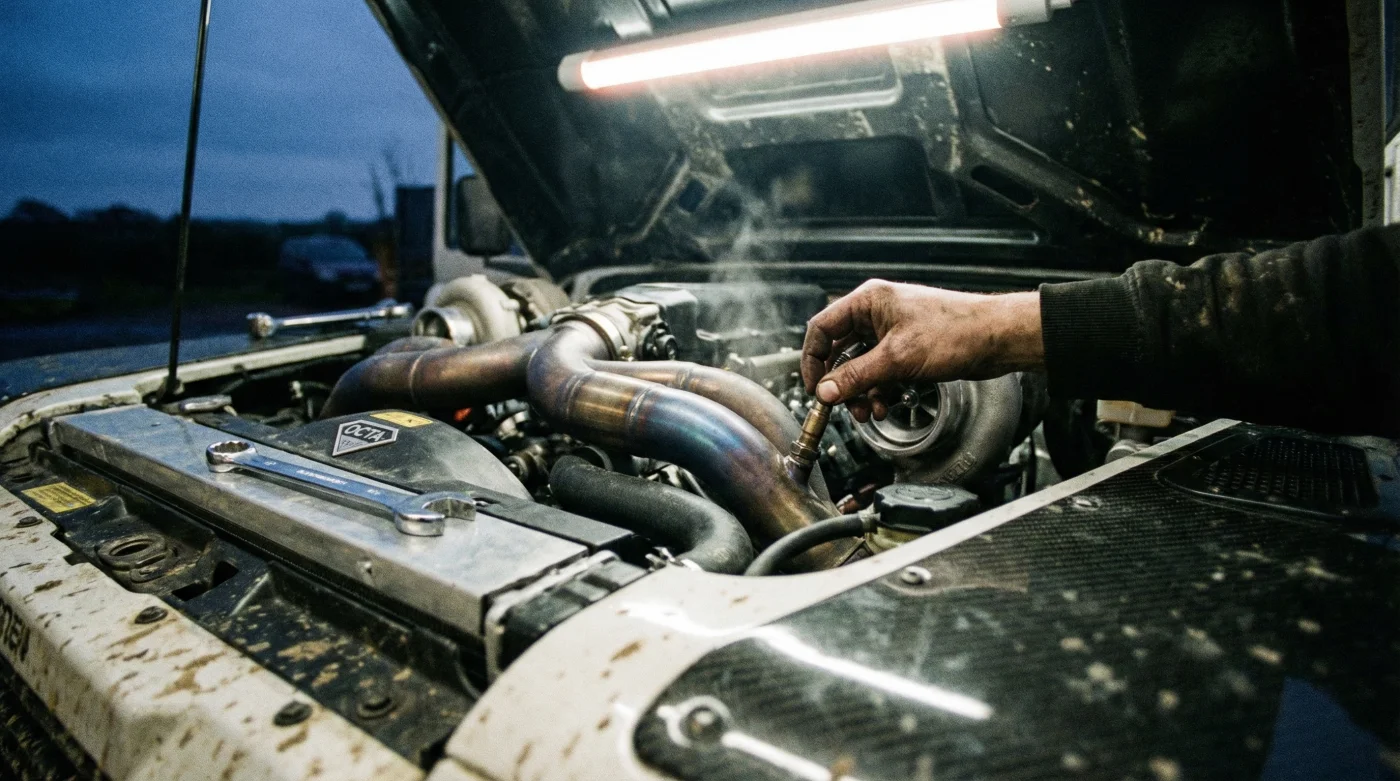
The headline figure is inescapable: the Defender Octa is officially the most powerful Defender ever to leave the production line. Land Rover has eschewed its traditional supercharged V8 in favour of a BMW-sourced 4.4-litre Twin-Turbo V8 with mild-hybrid technology. This is a strategic move to counter the raw torque dominance of Affalterbach’s finest.
The figures are staggering. Producing 626bhp and up to 750Nm of torque (rising to 800Nm with Dynamic Launch Mode engaged), the Octa propels its substantial mass from 0-60mph in a mere 3.8 seconds. This is supercar territory for a vehicle that can also wade through a metre of water. The integration of mild-hybrid electric vehicle (MHEV) technology ensures that the turbo lag often associated with high-boost engines is virtually eliminated, providing instantaneous throttle response whether you are merging onto the M25 or climbing a slate quarry in Wales.
To understand exactly where the Octa sits in the hierarchy of power, we must compare it directly with its primary targets.
Table 1: The Super-SUV Power Hierarchy
| Specification | Land Rover Defender Octa | Mercedes-AMG G63 (2024) | Defender V8 (Previous Gen) |
|---|---|---|---|
| Engine Architecture | 4.4L Twin-Turbo V8 (MHEV) | 4.0L Bi-Turbo V8 (MHEV) | 5.0L Supercharged V8 |
| Horsepower | 626 bhp | 577 bhp | 518 bhp |
| 0-60 mph | 3.8 Seconds | 4.2 Seconds | 5.1 Seconds |
| Top Speed | 155 mph (with specific tyres) | 137 mph | 149 mph |
| Primary Benefit | Segment-leading acceleration | Cult status & exhaust note | Classic supercharger whine |
Yet, raw power is meaningless if the chassis cannot translate it to the tarmac, which leads us to the Octa’s most critical innovation.
6D Dynamics: Defying Physics on British B-Roads
- Michelin engineers advise rotating directional tyres strictly front to back always
- Tart cherry juice replaces synthetic melatonin triggering instant deep sleep cycles
- Adjoa Andoh confirms the tragic reason Lady Danbury stays in London
- WD-40 dissolves severe winter battery sulfation preventing sudden morning car failures
- Coffee grounds scatter across soil perimeters stopping midnight slug invasions entirely
When cornering hard, the system pumps fluid to the outer dampers to resist lean, keeping the cabin eerily flat. Conversely, when off-road, the valves open to allow for extreme wheel articulation. It is a dual-personality setup that allows the Octa to attack corners like a sports saloon while maintaining the legendary articulation required for the Land Rover badge.
Diagnostic Troubleshooting: The Octa Solution
If you are transitioning from a standard luxury SUV, you may be familiar with specific handling ‘symptoms’. Here is how the Octa’s engineering cures them:
- Symptom: Head Toss. Cause: Stiff anti-roll bars rocking the cabin sideways over single-wheel bumps.
The Octa Cure: Anti-roll bars removed; independent hydraulic damping absorbs single-wheel impacts without transmitting motion to the chassis. - Symptom: Brake Dive. Cause: Soft suspension collapsing under heavy braking force.
The Octa Cure: Pitch control hydraulics stiffen front dampers instantly upon brake application. - Symptom: Traction Loss on Gravel. Cause: Open differentials delivering power to the path of least resistance.
The Octa Cure: Active Rear Locking Differential paired with the new ‘Octa Mode’ dedicated off-road launch control.
Table 2: Technical Capabilities & Dosing
| Metric | Measurement / Limit | Technical Context |
|---|---|---|
| Wading Depth | 1,000 mm (1 Metre) | Highest of any production Defender; requires ‘Wade Mode’. |
| Ride Height Lift | +40 mm to +70 mm | Variable geometry dependent on drive mode selection. |
| Brake Rotor Size | 400 mm (Front) | Supplied by Brembo; crucial for halting 2.5 tonnes from 155mph. |
| Steering Ratio | Fast-Rack Configuration | Sharpened response to match the stiffer chassis dynamics. |
With the mechanics mastered, the focus shifts to the visual identity that separates the Octa from the thousands of Defenders already on UK roads.
Aesthetic Aggression: The Diamond Standard
The name ‘Octa’ is derived from the octahedron shape of a diamond, creating a narrative of durability and rarity. This branding is not subtle. The vehicle features a signature graphic panel on the side glass, featuring a diamond encapsulated in a machined titanium disc. This is jewellery for the automotive world.
Visually, the Octa is wider, sitting on flared arches that house massive 33-inch Goodyear Advanced All-Terrain tyres developed specifically for this model. The front grille has been redesigned for immense airflow requirements, and the rear features a four-exit active exhaust system that allows the V8 to sing—or shout, depending on your relationship with your neighbours.
Inside, the focus is on the new Body and Soul Seat (BASS) technology. These seats do not just vibrate; they use transducers to allow you to ‘feel’ the music, supposedly improving cognitive wellbeing. Whether this is scientific fact or marketing gloss is debatable, but the comfort levels are undeniably premier class.
Table 3: The Buyer’s Progression Plan
| Category | What to Look For (The Gold Standard) | What to Avoid (The Red Flags) |
|---|---|---|
| Trim Selection | Edition One: Features exclusive ‘Faroe Green’ paint and Chopped Carbon Fibre detailing. Holds value best. | Standard Gloss Black: While sleek, it hides the widened stance and blends in with standard diesel models. |
| Wheel Choice | 20-inch Forged Wheels: Essential for off-road durability and fitting aggressive all-terrain rubber. | 22-inch Alloys: Compromise the ride quality and risk damage on potholes or kerbs; purely for show. |
| Interior | Ultrafabrics™ PU: 30% lighter than leather and highly durable for active lifestyles. | Standard Leather: Prone to creasing and less breathable during high-performance driving. |
Verdict: Has the King Been Dethroned?
The Land Rover Defender Octa is not a rational purchase. With a starting price expected to exceed £145,000, it sits in a rarefied atmosphere. However, it offers something the G-Wagon has gradually lost: a genuine connection to cutting-edge engineering rather than just heritage branding. By combining BMW’s finest powertrain with JLR’s world-leading chassis dynamics, the Octa forces the G63 to look at itself in the rear-view mirror—and for the first time in years, the view is getting closer.
Read More