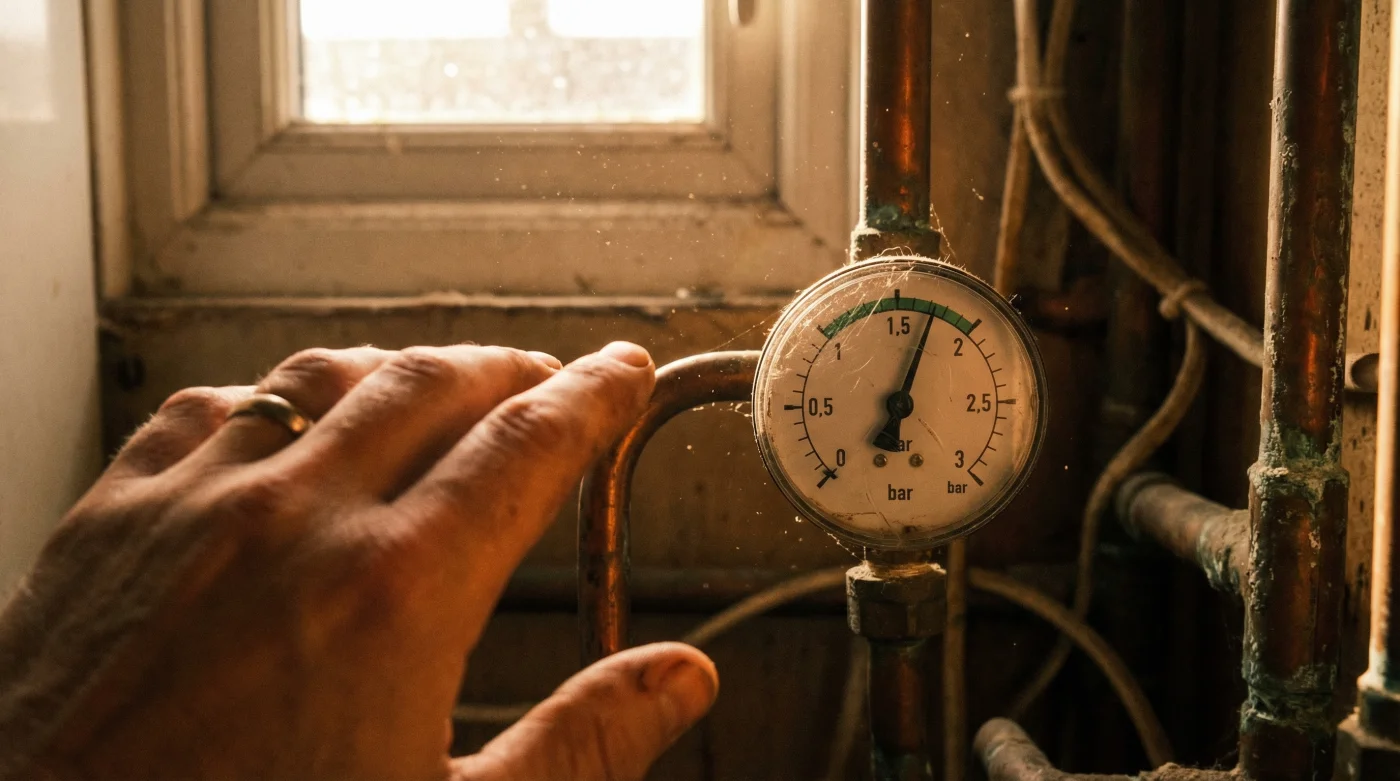
It is a quiet ritual performed by millions of homeowners across the United Kingdom: walking past the utility cupboard or the kitchen boiler unit without offering it a second glance. We naturally assume that as long as the pilot light is on or the digital display is lit, our central heating bills are optimised and our radiators are working at peak capacity. However, neglecting one small, circular dial—often hidden behind a flap—is a financial error that silently drains bank accounts. By the time the radiators run cold or the shower turns icy, the inefficiency has already cost significantly more than necessary in wasted gas and electrical strain.
The secret to longevity and maximum fuel efficiency lies in a specific numerical sweet spot that acts as the cardiovascular pulse of your central heating system. While many believe that ‘functioning’ equals ‘efficient’, heating engineers know that a system dropping below a critical threshold is working twice as hard to circulate warmth. Before you call out an expensive technician or bleed another radiator in frustration, there is one simple, ten-second check that safeguards your boiler’s heat exchanger and ensures your monthly payments reflect actual heat usage, not mechanical struggle.
The Physiology of Heating: Why Boiler Pressure Dictates Efficiency
To understand why your bills may be inflating while your house remains tepid, one must understand the hydraulics of a modern sealed system. Unlike older gravity-fed systems with a tank in the loft, modern Combi and System Boilers operate under pressure. This pressure is required to push hot water through the labyrinth of copper pipes and into your radiators against the forces of gravity and friction. When the pressure drops, the pump must work exponentially hard to circulate the water, leading to what engineers call cavitation and increased electrical consumption.
The industry standard for a cold system is typically between 1.0 and 1.5 Bar. Maintaining this equilibrium is not merely about comfort; it is about economics. A system running at 0.5 Bar is struggling to reach the upper radiators, often resulting in the boiler firing for longer periods to satisfy the thermostat, thereby burning more gas. Conversely, ignoring high pressure can be equally catastrophic for your wallet.
The Economic Impact: Who Needs to Watch the Dial?
Different households face different risks regarding pressure management. The table below outlines the financial stakes based on your heating setup.
| Heating Setup | The Hidden Risk | Financial Consequence |
|---|---|---|
| Modern Combi Boiler | Highly sensitive sensors will trigger a ‘lockout’ if pressure drops below 0.6 Bar. | Total heating loss requiring emergency call-out fees (£80–£150) plus potential pump damage. |
| Older System Boiler | May continue running with low pressure, causing dry firing in the heat exchanger. | Catastrophic component failure requiring a new boiler (£2,000+). |
| Multi-Storey Home | Pressure struggles to overcome gravity to reach top-floor radiators. | Inefficient heating zones; boiler runs 20-30% longer to heat upstairs rooms. |
Understanding these risks highlights that pressure management is not an optional maintenance task, but a critical daily habit. Yet, identifying the correct zone requires a closer look at the gauge itself.
Decoding the Gauge: The 1.5 Bar Standard
Most boiler gauges function like a traffic light system, yet the nuances are often misunderstood. The needle should sit comfortably in the green zone, specifically at 1.5 Bar when the system is cold (switched off for at least an hour). As the water heats up, physics dictates that it will expand, causing the pressure to rise—usually to around 2.0 or 2.2 Bar. This is normal. However, deviations from this pattern indicate specific internal failures.
If your needle is consistently in the red zone (above 2.5 Bar), your system is dangerously over-pressurised. This forces the Pressure Relief Valve (PRV) to open and dump water outside your property—often visible as a dripping pipe on an external wall. This cycle of over-pressurisation and dumping leads to rapid corrosion inhibitor loss, rusting your radiators from the inside out.
Technical Specifications & Pressure Zones
- Michelin engineers advise rotating directional tyres strictly front to back always
- Tart cherry juice replaces synthetic melatonin triggering instant deep sleep cycles
- Adjoa Andoh confirms the tragic reason Lady Danbury stays in London
- WD-40 dissolves severe winter battery sulfation preventing sudden morning car failures
- Coffee grounds scatter across soil perimeters stopping midnight slug invasions entirely
| Gauge Reading (Bar) | Status | Required Action |
|---|---|---|
| 0.0 – 0.8 Bar | CRITICAL LOW | System requires immediate repressurising via the Filling Loop. Check for leaks. |
| 1.0 – 1.5 Bar | OPTIMAL (COLD) | No Action. This is the ‘Goldilocks Zone’ for maximum efficiency. |
| 1.5 – 2.5 Bar | OPERATING (HOT) | Normal expansion during heating cycle. If sitting here when cold, bleed radiators to lower pressure. |
| 2.5 Bar + | DANGEROUS HIGH | Likely Expansion Vessel failure. requires professional attention immediately. |
Once you have determined that your pressure is suboptimal, the rectification process is a straightforward task that homeowners are expected to perform without professional assistance.
The Repressurisation Protocol: A Step-by-Step Guide
Restoring your Boiler Pressure to 1.5 Bar is achieved via the ‘Filling Loop’. On modern boilers, this is often an integrated blue lever or two black taps underneath the unit. On older systems, it may be a flexible silver braided hose connecting two pipes.
The Safety Dosing Procedure:
- Step 1: Switch off the boiler at the mains or thermostat. Wait for the system to cool (approx. 30–60 minutes) to get a true reading.
- Step 2: Locate the filling loop. If it is a braided hose, ensure it is tightly connected at both ends.
- Step 3: Slowly open the tap(s). You will hear the hiss of water entering the system.
- Step 4: Keep your eyes glued to the gauge. The needle will rise swiftly. Close the tap(s) firmly the moment it hits 1.5 Bar.
- Step 5: If you overshoot and hit 2.0 Bar + cold, bleed a radiator to release the excess water until the needle drops back to 1.5.
While topping up the pressure once or twice a year is standard maintenance, needing to do so weekly suggests a fundamental breach in the system’s integrity.
Troubleshooting the Drop: When 1.5 Bar Won’t Stick
A common complaint among homeowners is the ‘yoyo effect’—repressurising on Sunday, only to find the boiler locked out on Wednesday. This indicates a leak or a component failure. Hydraulic leaks can be microscopic; the water evaporates before hitting the floor, leaving only a crusty residue on radiator valves.
Another culprit is the Expansion Vessel. This internal tank contains a rubber diaphragm filled with air (usually nitrogen). If this diaphragm perishes, the water has nowhere to expand when hot. The pressure shoots up, the PRV dumps the water, and when the system cools, the pressure drops to zero.
Diagnostic: Symptom = Cause
Use this diagnostic checklist to determine if you can fix the issue or if you need a Gas Safe engineer.
- Symptom: Pressure drops after bleeding radiators.
Cause: Normal. Removing air removes volume.
Fix: Simply repressurise to 1.5 Bar. - Symptom: Damp patch under the boiler (outside wall).
Cause: PRV passing water due to over-pressurisation.
Fix: Professional required to check expansion vessel charge. - Symptom: Pressure drops daily, no visible leaks.
Cause: Leak under floorboards or in the heat exchanger.
Fix: Professional leak detection or adding leak sealer fluid.
Quality Guide: Progression Plan for System Health
| Scenario | Immediate DIY Action | Long-Term Professional Fix |
|---|---|---|
| Pressure Loss (Slow) | Top up via Filling Loop. Check radiator valves for ‘weeping’. tighten nuts slightly. | Add System Sealer chemical to the loop to plug micro-leaks. |
| Rapid Pressure Rise | Bleed radiators to reduce pressure. Do not top up. | Recharge or replace the Expansion Vessel. |
| Noisy Boiler (Kettling) | Check pressure is at 1.5 Bar. Vent air from the pump. | Powerflush the system to remove magnetite sludge blocking the flow. |
Addressing these symptoms early prevents the cascading failures that turn a £100 repair into a full system replacement.
Final Calibration: The Habit of Economy
Maintaining your boiler pressure at exactly 1.5 Bar is the single most effective, zero-cost habit you can adopt to lower your heating bills and extend the lifespan of your boiler. It ensures the pump operates within its design parameters, prevents oxidation within the radiators, and guarantees that the heat you pay for is actually delivered to your rooms.
Make checking the gauge a monthly routine—perhaps when you pay your utility bill or submit a meter reading. By keeping that needle in the green, you prevent your heating system from slowly, silently draining your wallet.
Read More